emancipatory social science
This was post 3 of my 2025-26 #100DaystoOffload challenge. originally published on my Method Quest ghost blog, that I migrated here in September 2026.
∿∿∿
One thinker I admire a lot is Erik Olin Wright (RIP). He did a lot of work on better understanding class and power; on "envisioning real utopias"; and elaborating a framework for anticapitalist coalitions (including those who just want to "tame" and reduce the harms of capitalist systems, and those who fully want to dismantle capitalism-as-dominant-economic-system).
Today I am simply drawing attention to one facet of his work that I like: his definition of "emancipatory social science".1
This is partly motivated by self-reflection since my last post: woah, that was too niche, way off the deep end. What's the relevance? How does that connect to the big picture I'm touting, about effective collaboration and systems change?
Well, rigorous research should be the basis for projects that aim to make the world better and more wonderful. Rigorous research has to have good research design. And good research design includes explicit thinking about theoretical assumptions, philosophy, methods etc. (Or at least we should strive for all of these things and be aware of our limitations and shortcomings!)
And that brings us to Erik Olin Wright's concept of emancipatory social science.
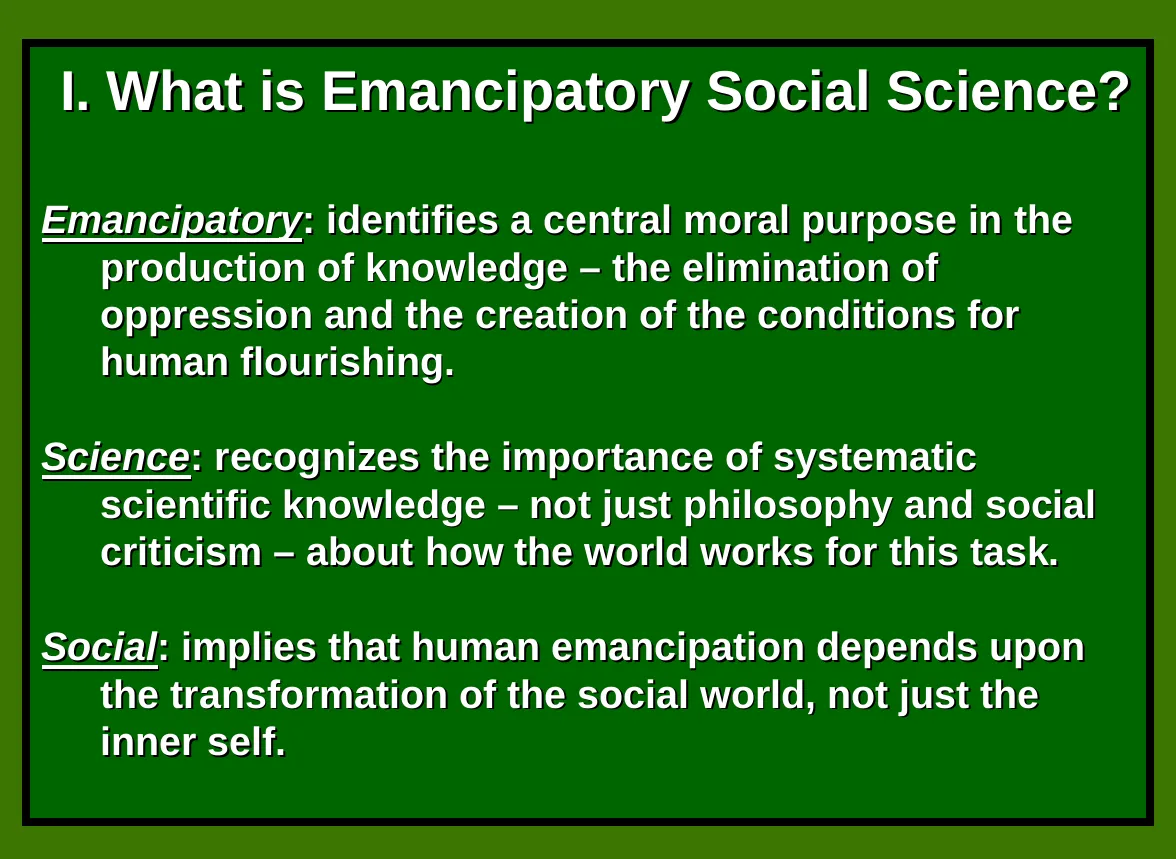 From Wright (2007), a presentation titled "A Framework for
Emancipatory Social Science". Source file here
From Wright (2007), a presentation titled "A Framework for
Emancipatory Social Science". Source file here
We need to understand how the world works in order to produce useful knowledge and make change. and that includes adequately understanding the processes of learning, knowledge production and social interactions! That's why - if you're doing academic research - I don't think it's okay to be fuzzy or neglectful or incoherent about research philosophy (ontology and epistemology).
And in the specific case of some academic researchers claiming that certain research methods only work if you assume certain philosophical (epistemological) or theoretical positions... That's a fairly big claim to make if it is going to influence how people conduct research, and what people believe is possible or rigorous or credible.
Other things I like about this term and the definitions of its component parts:
- The way I want my research and work to contribute to the world is perfectly encapsulated in the idea of it being "emancipatory", having moral purpose to eliminate oppression and/or create conditions for flourishing. I would expand it beyond the human, though.
- Recognising the interactions of social structures/systems and agency/inner self. What I plan to get deeply into in my PhD project is how changes in the macro structure - of a social network - relate to changes at the micro level - individual perspectives and dyad (pair) or small group interactions. This might be able to reframe or expand on what Wright gestures at here.
In future posts I may well come back to Wright's work, because I find a lot of his theory and frameworks very helpful. Particularly his 3 criteria/steps for evaluating possible alternatives to existing social structures: thinking through in turn if something is desirable, viable and finally achievable (for now, see the file linked above).
For today this can be one small, initial, hastily drawn, line for joining the dots between abstract research philosophy discussions and practically relevant research.
Since first encountering this, I've become aware that the term "emancipation" might have heavy Marxist connotations for folks with those leanings/learnings. Just to be clear, I'm not a Marxist, tho some thinkers and researchers I draw on might describe themselves that way, or be part of a Marxist lineage.↩